
Why ChatGPT and Copilot licenses don't stick at GCs (and what to build instead)
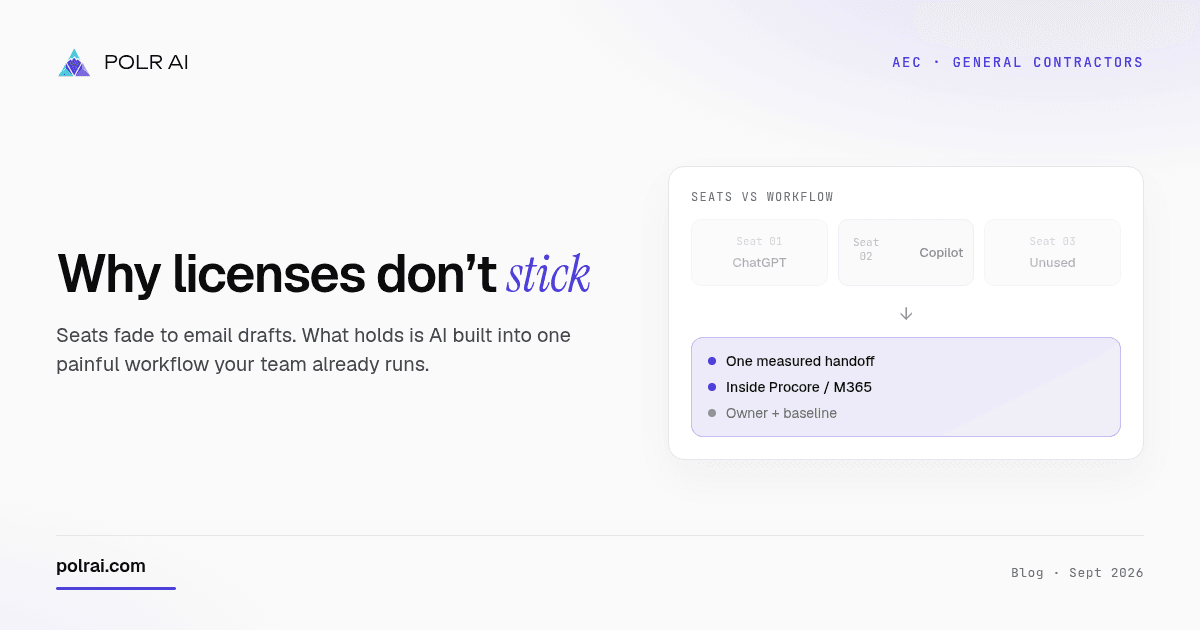
You bought the seats. You ran the lunch-and-learn. Estimating, submittals, RFIs, and Friday reporting still look the same.
That pattern is familiar on general contractor and AEC teams. ChatGPT handles a few email drafts. Copilot helps in Word. The real work still lives in Procore, Excel, SharePoint, and the inbox. A license is access, not a workflow.
I build AI into the work you already do. When seats did not change the work, the next move is not more seats. It is one painful workflow, built with your team, measured against a baseline, and left with an owner who can run it.
What "didn't stick" actually looks like
Usage does not usually crash to zero. It thins out.
Someone still opens ChatGPT for a polite client email. Someone still asks Copilot to tidy a paragraph. Meanwhile bid leveling stays in the same spreadsheet. Submittal first passes still wait on the same person. Status reports still get rebuilt every Friday from three systems that do not talk to each other.
If that is your firm, you do not have an "AI strategy" problem first. You have a workflow problem that seats alone cannot solve.
Why seats fail (even when the model is fine)
The work lives somewhere else
Generic chat sits beside the systems where the job actually moves. It does not own the handoff from RFI to response, from RFP section to compliance matrix, or from field update to owner report. Until outputs land back in the tools people already open, the model stays optional.
No measured workflow, no owner
A pilot without a baseline is a demo with a calendar invite. A pilot without a frontline owner after the vendor leaves is a quiet abandonment waiting to happen. Someone has to care about the before-and-after number and the exceptions list when the excitement fades.
Demo data isn't your data
Trade coverage such as ENR's reporting on ChatGPT at the jobsite keeps landing on the same foundation issue: messy project data. Scanned PDFs, inconsistent naming, and information split across SharePoint, Procore, and inboxes. Clean sample files make any model look sharp. Your Tuesday afternoon folder does not.
Shadow use and governance fear
When people paste proprietary language into public tools, IT and counsel pull the brakes, for good reason. Fear without a safe path does not create better work. It creates quiet workarounds or no use at all. Governance belongs in the design of the workflow, not as a slide after go-live.
What the market already says (and where it stops)
Trade press and vendors largely agree: the model is rarely the failure mode. Data, problem selection, bolt-on chatbots, and weak ownership are.
Where most "solutions" go next is one of two places. Buy another AEC AI product login. Or customize Microsoft Copilot Studio for your tenant. Both can be right for some firms. Neither is the only middle path.
The gap I keep seeing: build the workflow into the stack you already run, train someone on your team to own it, and prove the change in ninety days before you scale anything.
That middle path is also how you avoid two expensive mistakes. The first is collecting unused seats while the core handoffs stay manual. The second is ripping the team into a new platform before you have proven that one workflow can stick in daily production.
What to build instead
One painful, expensive workflow, not an AI strategy deck
Pick work with a clear beginning, end, and cost. Examples that show up often for GCs and AEC ops teams:
- Friday status reporting assembled from multiple systems
- Bid leveling inside templates you already use
- Submittal or RFI first pass for human review
- Internal questions answered from approved project files
- Proposal or SOQ assembly from past performance you already own
One workflow, one baseline, and one owner.
Inside tools you already open
Procore, Microsoft 365, SharePoint, existing drives and permissions. The point is not a new dashboard to remember. The point is a better path through the software your team already trusts on a deadline.
Built with the team so someone owns it
I sit with the people who do the work. We build on live examples, not slideware. At the end of a focused engagement, your nominated owner can run daily use and routine exceptions. Technical maintenance may still need a specialist. Daily operation should not depend on me forever.
What a 90-day path looks like
The 90-Day AI Sprint is how I package that middle path.
Prioritize. Map the work. Compare opportunities. Agree on scope and a baseline you can actually measure: hours, cycle time, rework, or another honest number for that workflow.
Build. Develop in usable increments inside your tools and permissions. Your workflow owner is in the room from the start. Testing happens while we build, not only at the end.
Prove. Roll out the agreed workflow. Train the owner. Review results against the baseline. Rank what to improve next.
If the first workflow earns its keep, the next quarter gets easier because permissions, patterns, and trust already exist. That is compounding. It is not a year-two transformation promise.
You should leave a Sprint able to answer three plain questions. What changed in the work? Who runs it on a normal Tuesday? What are we not automating yet on purpose? If you cannot answer those, you are still in demo territory.
When more Copilot or ChatGPT seats are enough
Be honest about the carve-out. Off-the-shelf Copilot and ChatGPT are useful for Office productivity, light research, and drafting when the work truly lives in documents and mail.
They are not a substitute for AEC-specific workflow design when the bottleneck is Procore handoffs, submittal packages, bid files, or reporting that spans systems. More seats will not fix a process that was never designed for AI to run inside it.
FAQ
Why don't ChatGPT or Copilot licenses stick at general contractors?
Because a license is access, not a workflow. GCs buy seats and run a lunch-and-learn, but estimating, submittals, RFIs, and reporting still live in Procore, Excel, and email. Generic chat sits beside that work, so usage fades to drafting emails. What sticks is AI built into one painful, measured workflow, with an owner, a baseline, and outputs that land back in the tools the team already opens.
What's better than buying more Copilot or ChatGPT seats for an AEC firm?
Purpose-fit workflow automation inside systems you already run, not another login and not a platform rip-and-replace. Start with one high-cost handoff (submittal review, RFI drafting, proposal assembly, status reporting), build against your real data and permissions, train by doing the work together, and expand only after you can show before-and-after hours or cycle time. Off-the-shelf Copilot remains useful for Office productivity; it is not a substitute for AEC-specific workflow design.
Why do construction AI pilots fail even when the demo looked great?
Demos run on clean sample files; your firm runs on scanned PDFs, inconsistent naming, and data split across SharePoint, Procore, and inboxes. Pilots also fail when leadership mandates the tool without a frontline champion, when no one owns adoption after the vendor leaves, and when success is declared before the workflow is in daily production. Fix the problem definition and the path into live work first. The model was rarely the bottleneck.
How is this different from buying another AEC AI product?
I build into the tools and permissions you already use. If a specialized product is truly the right home for a workflow, we can say so. The default is not another seat product to adopt before the work is clear.
Closing
If seats did not change the work, stop buying seats and pick one workflow to build.
Book a Call and tell me which handoff is slow or expensive. Or go straight to the 90-Day AI Sprint to see how Prioritize, Build, and Prove work on one measured workflow inside tools you already open.
For broader AEC context, see AI for AEC.