
Built for a team that can name the slow work and join the rebuild.
The sprint fits when you have a workflow that is actually slow or expensive, an internal owner who can participate, and access to the systems that work already uses. I work with architecture, engineering, and construction teams, and with manufacturing, distribution, and other operations teams when the work is similar.
This is not a company-wide transformation program and not a promise that every team becomes a full AI-native company. We match complexity to the need, keep people in control where the work requires it, and leave a reusable foundation for the selected workflow.
One defined workflow, plus what your team can reuse.
Default scope is one agreed workflow. Ranked next opportunities come from that discovery, not from a company-wide audit. Integrations are subject to access and feasibility.
Prioritize, build, and prove as overlapping work.
The three names describe emphasis, not sealed phases. Discovery, building, testing, and practice run across the ninety days so the team is not waiting until the end to touch the new path.
Prioritize
We name the desired outcome, question steps that waste time, and set a baseline for the selected workflow. Discovery looks past only the familiar tasks when a quieter step is where the time actually goes. Your owner is in these conversations from the start.
Build
We rebuild the path, keep maintained context in reach, and put review where the work needs a person. Your team practices the new work on live examples. Testing and participation continue here. They are not saved for the last month.
Prove
We review quality, adoption, and operating cost alongside speed. Financial return is discussed only when costs and benefits can be established. The same owner who practiced the work helps evaluate whether it is ready for daily use.
Start with the work. Check what already exists.
Custom software is one option. I work through these choices in order, comparing the ongoing cost and support burden along with the effort to build.
- 01
Remove unnecessary steps
First, question the work itself. A step that can go away does not need automation.
- 02
Use what you already own
Check the capabilities in your existing software and licensed AI tools.
- 03
Consider a suitable product
Compare off-the-shelf options with the need, ongoing cost, and support burden.
- 04
Connect existing systems
Use the data and systems already in the workflow when access and permissions allow.
- 05
Build custom where it fits
Scope custom development when the earlier options cannot meet the need.
Before committing to an integration, we confirm permissions, data export or API access, operating costs, support needs, and an internal owner. That includes checking the actual setup of tools such as Procore, Sage, Viewpoint, Deltek, and Bluebeam.
Decide where AI helps and where people stay in control.
We expand automation when the results justify it and keep human review where the work requires it. We agree when the tool may act, when it may only look, and when we pull that back.
These four levels are choices for a given piece of work. They are not a ladder every team has to climb, and more automation is not always better.
We match complexity to the need. You do not have to become a full AI-native company, and not every leader needs to become a developer. We judge quality, usefulness, cost, and adoption, and we leave room to experiment.
Human-led
A person does the work. AI is not in this path.
AI-assisted
AI drafts or finds material. A person decides what to use.
Approval-based
AI prepares an action. A person approves it before anything is sent or changed.
Automated
The tool acts inside agreed limits. People review exceptions.
Your owner stays in the work. We measure against a baseline we set together.
Compare bids with the scope in view.
Different formats, missing line items, and exclusions make bids hard to compare. A structured comparison helps the team see what needs a closer look.
This walkthrough uses fictional bid information to explain the work. It does not report measured client results.
See the bid-leveling walkthrough| SCOPE ITEM | BID A | BID B | BID C |
|---|---|---|---|
| Preparation | Included | Included | Included |
| Protection | Included | Not stated | Included |
| Cleanup | Included | Included | Excluded |
Your team verifies the sources and decides.
Gather the bids
Bring the proposals and the scope of work together. Keep the original documents available.
Structure the comparison
Use assistance to organize scope, inclusions, exclusions, and questions that need an answer.
Review before deciding
A person checks the comparison against each source, confirms prices and scope, and makes the award decision.
Before claiming time saved, we need a confirmed baseline and comparable runs that include preparation, review, and correction time.
See what matters, who owns it, and what is moving.
I use POLR Tracker to keep our work in view: ranked opportunities, internal owners, sprint milestones, blockers, and the evidence behind a result. We review it together as decisions and delivery move forward.
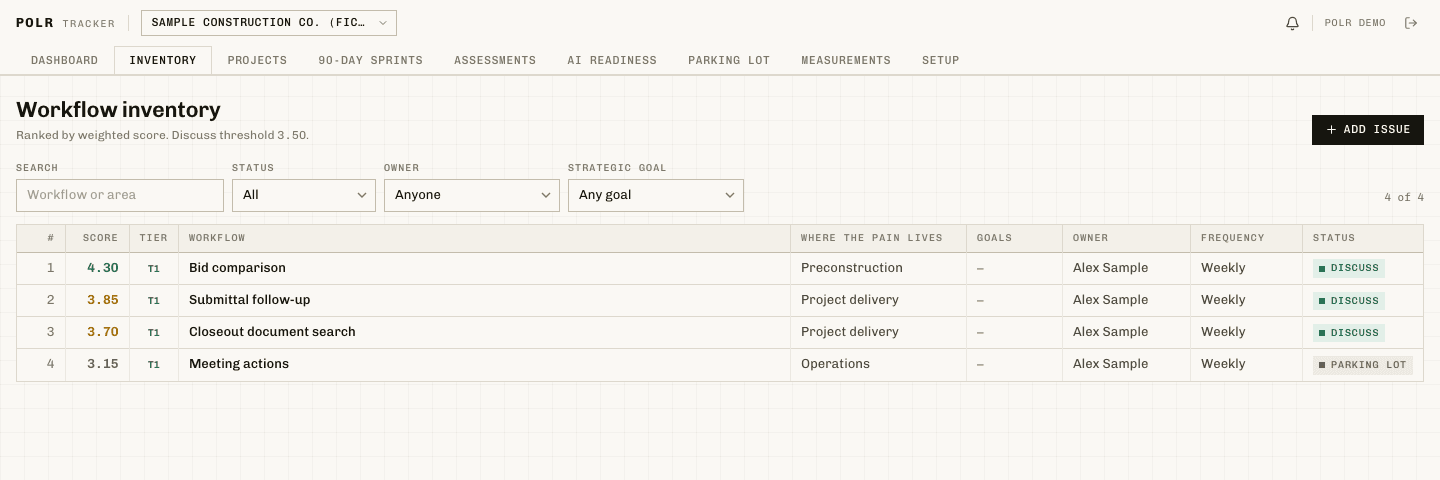
Agree on the next priority
Weighted criteria make the reasoning visible. A priority score helps rank opportunities; it is separate from workflow readiness.
Actual interface · Fictional sample data
Open full-size screenshot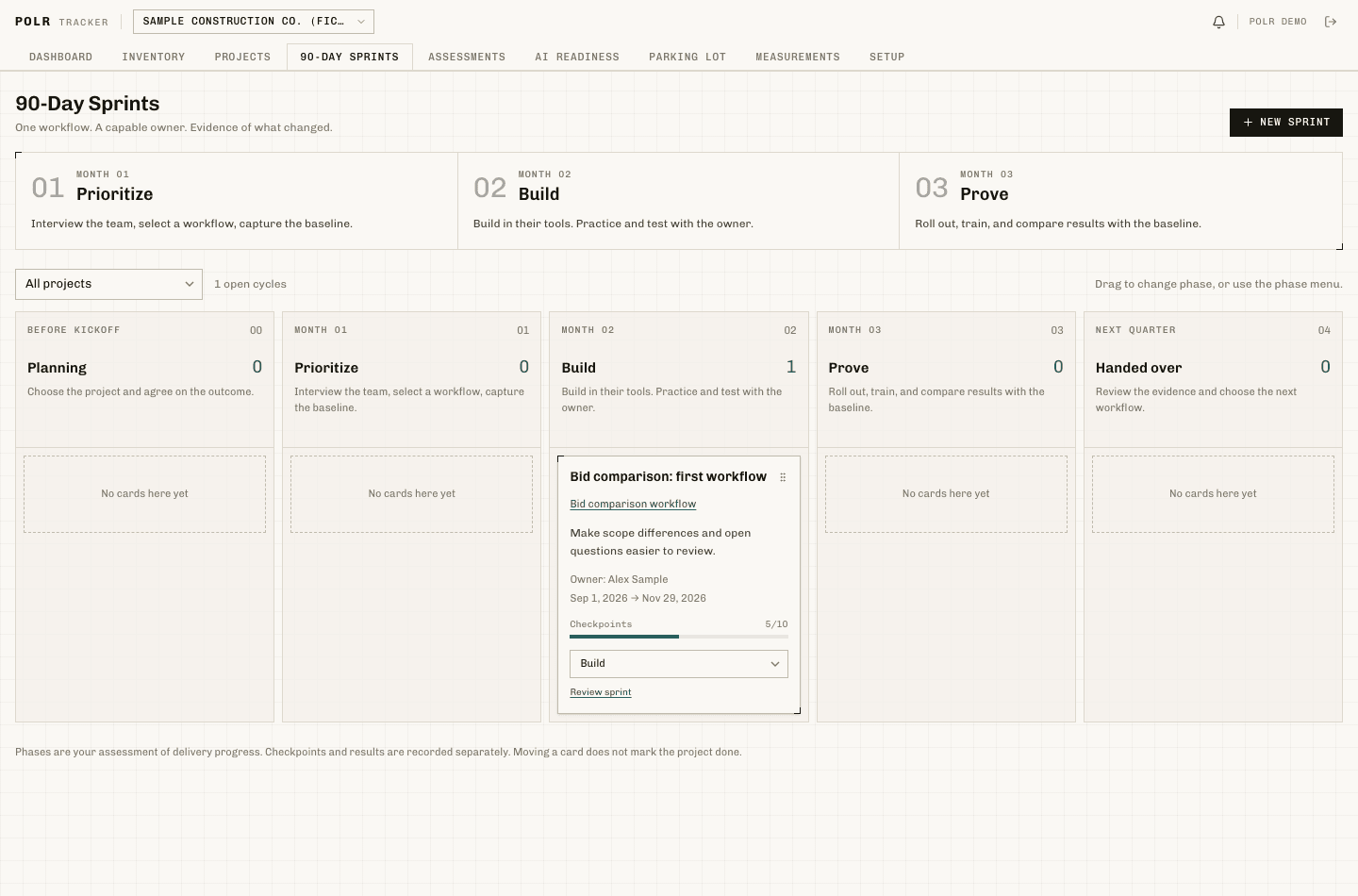
Keep delivery and evidence together
The selected workflow has an owner, a baseline, and checkpoints for practice, testing, rollout, and review.
Actual interface · Fictional sample data
Open full-size screenshotKeep improving the work, together.
If we continue after the first sprint, we choose the next workflow together and keep a ranked backlog. I build alongside your team, with practical training, office hours, advisory support, and rollout guidance inside the agreed scope. We review adoption, quality, operating cost, and results as the work progresses.
Work is paid monthly within an agreed engagement. We scope the next cycle together. Custom applications, infrastructure, substantial integrations, and additional development are scoped separately.
Your internal owner runs daily use and routine exceptions. I own the implementation commitments in our engagement. We agree on software, maintenance, and support responsibilities so the boundaries stay clear.
Questions worth answering first.
Still exploring? Start with the AI assessment.
Tell me which workflow is worth ninety days.
Bring the work that is actually slow or expensive. I will tell you honestly whether it is a good first sprint.
Book a Call